Train Window Toy Car AI Video: Make the Tunnel Transition from One Photo
Last updated:
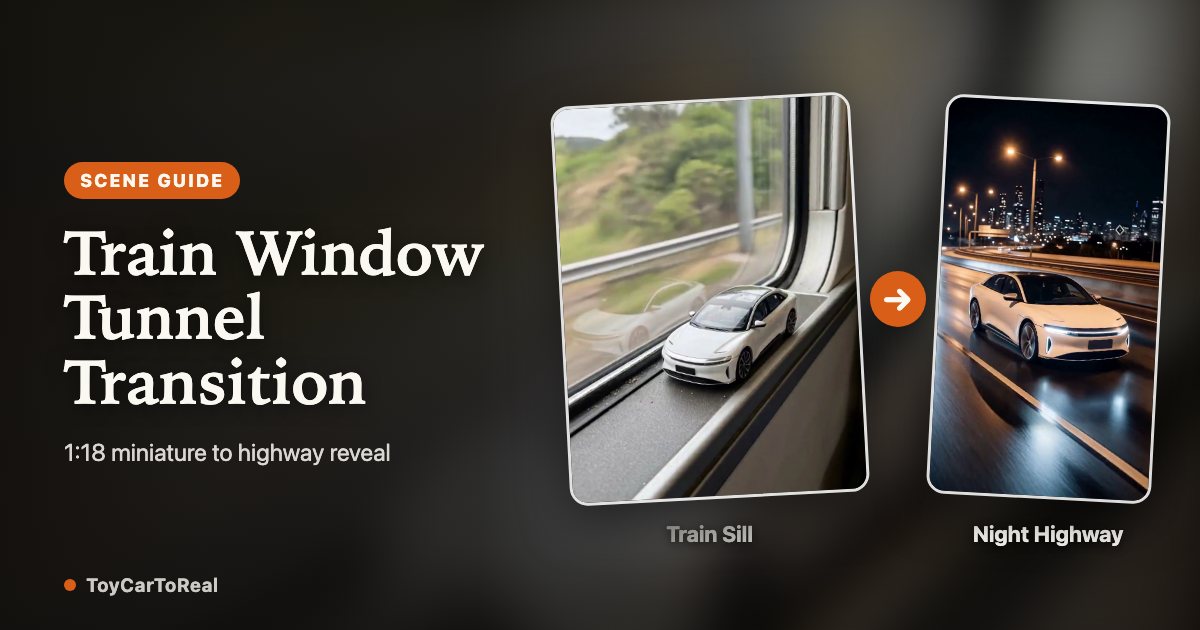
The train window toy car video became one of short-form social media’s cleanest automotive reveals because every viewer understands the visual grammar in half a second: a 1:18 die-cast miniature rests on a passenger train window sill while scenery streaks past outside, the carriage plunges into a dark tunnel, and the camera pushes through the glass onto an open highway where the exact same car is driving at full scale. Popularized in October 2026 by creator @umutcancelikis (with whom ToyCarToReal has no commercial affiliation), the effect no longer requires owning a matching scale model or splicing two separate video shoots. Here is how the train-window optical handoff works and how to generate a clean ~10s or ~15s 9:16 MP4 from one car photo.
See the Toy Car to Real Car transformation
1. Why the train window sill makes the scale jump believable
Placing a toy car on an ordinary desk or driveway pavement gives the viewer only one depth plane. A passenger train window creates two simultaneous speed and scale references in a single 9:16 vertical frame: a stationary interior sill within arm’s reach, and a fast horizontal blur of hills, fences, or city lights outside the glass. That foreground-versus-background parallax immediately tells the human eye the vehicle is palm-sized.
When the train enters a mountain tunnel or rock cavern, cabin reflections darken and overhead tunnel strip lights flash rhythmically across the glass. Pushing the virtual camera forward until the window frame expands past the screen borders removes the miniature reference right as the car’s headlights switch on—allowing the vehicle to scale up in place without an abrupt jump cut.
2. Comparing three train window toy car environments
Different car colors and body styles read better against specific window frames and exit roads. ToyCarToReal pairs three distinct train cabins with matching tunnel-to-highway exits using a dual-keyframe pipeline (Google Nano Banana 2.1 for start/end frame synthesis + MiniMax H3 for unbroken motion and environmental sound):
Wet Night Expressway opens inside a daytime commuter cabin before emerging from an urban tunnel onto a rain-slicked expressway where neon reflections highlight dark, silver, or metallic paint. Sunset Race Circuit starts on a modern high-speed bullet train sill passing trackside grandstands and exits a mountain tunnel onto a golden-hour circuit with red-and-white kerbs—ideal for sports coupes and bright colors. Coastal Cliff Highway places the miniature on a polished wooden vintage train sill overlooking pine ridges, glides through a lantern-lit rock cavern, and rolls out onto a blue-hour ocean cliff road suited to SUVs, trucks, and classic builds.
| Train Window Scene | Opening Cabin Sill | Tunnel Handoff | Full-Size Road Exit | Best Car Types & Finishes |
|---|---|---|---|---|
| Wet Night Expressway | Daytime passenger train ledge | Dark urban highway tunnel | Glossy night expressway | Sedans, black/white/silver paint, LED light bars |
| Sunset Race Circuit | High-speed bullet train window | Lit mountain railway tunnel | Golden-hour asphalt race track | Sports cars, coupes, red/yellow/blue liveries |
| Coastal Cliff Highway | Polished wooden scenic train sill | Warm lantern rock cavern | Twilight cliffside ocean road | SUVs, pickups, classics, earth & metallic tones |
3. How dual-keyframe orientation locking stops car flips
The number-one failure in DIY train window toy car AI videos is horizontal mirroring: a car facing right on the window sill spins 180 degrees inside the tunnel or spawns a second full-size car outside the train window while the miniature is still sitting on the ledge.
Our pipeline enforces two strict constraints before video diffusion begins. First, both the 1:18 miniature keyframe and the full-size rolling shot lock to the exact left-to-right bumper orientation and camera angle of your uploaded photo, replacing any readable number plate with a clean dark matte plate. Second, the motion prompt enforces a single-vehicle rule throughout the ~10-second or ~15-second take so a second car never appears outside the glass early.
4. Preparing a train window toy car photo for the cleanest window reflection
You only need one JPG, PNG, or WebP image (up to 10 MB)—either your real parked car or a die-cast model on a shelf. Shoot from a clean side profile or 3/4 front angle in even daylight with all visible wheels, both bumpers, and the roofline uncropped. Leave a small margin around the car so the keyframe model can seat the tires naturally onto the window ledge.
Avoid photos with people leaning on the doors, neighboring cars overlapping the fenders, harsh night streetlamp glare, or heavy color filters. Because AI video models synthesize motion frame by frame, fine details like multi-spoke alloy rims, tiny grille badges, and side mirrors can still shift slightly—always inspect your full rendered MP4 before posting.
5. Native train-to-engine audio and ~10s vs ~15s pacing
Silent clips lose half the punch on Reels, TikTok, and Shorts. Every render includes synchronized environmental audio generated alongside the video: subtle rail clatter and cabin hum in Act 1, a compressed tunnel whoosh in Act 2, and a smooth transition into engine rumble and tire pavement hiss in Act 3—with no synthetic voiceover or copyrighted music track.
Choose ~10s (9 credits in 480p or 12 credits in 768p HD) for a punchy hook, or ~15s (12 credits in 480p or 18 credits in 768p HD) if you want 4 full seconds on the train window sill before the tunnel and an extended 4-second highway sprint. One-time packs start at $6.99 (18 credits, never expire), and any failed render refunds its credits automatically.
FAQ
Do I need to film inside a real train to make the train window toy car video?
No. You upload a single photo of your real car or a miniature model taken anywhere in clear daylight. The AI pipeline synthesizes the passenger train cabin, window sill reflections, moving outdoor scenery, tunnel lighting, and open highway.
Can I upload a photo of a Hot Wheels or 1:18 die-cast model instead of a real car?
Yes. Both real vehicles and scale models work from a single photo. When photographing a small die-cast car, lower your phone lens down to the toy’s door-handle height in bright natural light so its proportions read like a full-scale vehicle.
Does the downloaded MP4 include train and car engine sound?
Yes. Renders output native 9:16 H.264 MP4 video with AAC stereo environmental audio—transitioning from train rail hum and tunnel whoosh into road engine and tire sound, with no visible watermark.
Should I choose ~10 seconds or ~15 seconds for TikTok and Instagram Reels?
Pick ~10s (from 9 credits) for a fast-paced loop that hits the tunnel reveal by second 4, or ~15s (12 credits in 480p, 18 credits in 768p HD) to give viewers longer to inspect the miniature on the window ledge and enjoy a full 4-second road cruise at the end.
What is the train window toy car AI video trend?
The train window toy car video is a scale-jump reveal: a 1:18 die-cast miniature sits on a passenger train window sill, the carriage enters a dark tunnel, and the next frame lands on the same car at full size on an open road. The format spread across Instagram Reels and TikTok in October 2026 after creator @umutcancelikis (with whom ToyCarToReal has no commercial affiliation) posted a version that needed no caption — the scale change reads in under a second, so it traveled across languages. Because the swap is hidden inside a dark interval, the effect can now be rebuilt from one car photo with AI video instead of matching a real miniature to a real car on a real train.
toy car to real car transition prompt templatesWhich train window toy car scene works best for my car color?
Match the cabin and the exit road to the paint you want to show. Dark, silver and metallic finishes hold up best on the wet night expressway, where neon reflections lift the body and soften panel noise. Red, yellow and blue sports cars read stronger on the sunset race circuit, because the golden-hour track puts a warm rim light along the roof and shoulders. SUVs, pickups and classics suit the coastal cliff highway, where the blue-hour ocean surface separates the silhouette from the sky. If your car is matte white or flat gray, try the cliff highway first — the sunset grade tends to flatten the contrast between roof and sky.
Your Toy Car to Real Car moment is one photo away
Create my video